Climate-Responsive House Design in India: A Practical Guide
01 Oct.


Published on 01 Oct
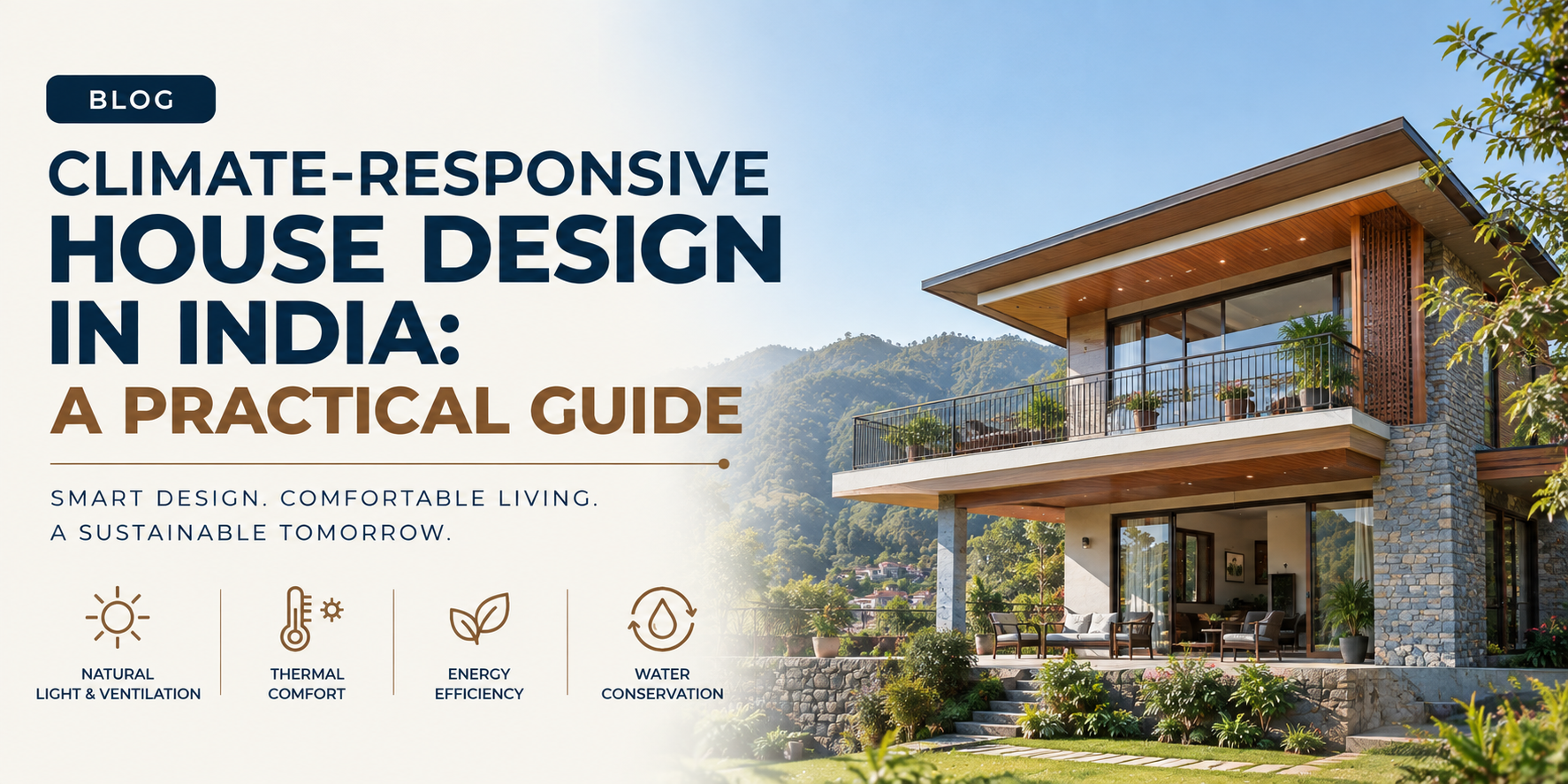
India has a wide variety of climates, from hot and dry regions to warm and humid coastal areas and cold Himalayan regions. Because of this, a house designed for one part of India may not perform equally well in another.
This is where climate-responsive house design becomes important.
Climate-responsive architecture means designing a home according to its local climate, sunlight, wind, rainfall, temperature, humidity and site conditions. Instead of depending completely on air conditioning, heating and artificial lighting, the building itself is planned to improve natural comfort.
For modern Indian homes, this approach can improve natural ventilation, daylight, thermal comfort, energy efficiency and long-term usability.
Climate-responsive architecture is a design approach where the building's:
are planned according to the surrounding climate.
The objective is not necessarily to eliminate mechanical systems, but to reduce unnecessary heat gain or heat loss and make the home naturally more comfortable.
Before designing a house, an architect should consider questions such as:
India's climatic conditions vary significantly between regions.
A home in Rajasthan may need protection from intense heat, while a coastal home may need maximum airflow and protection from humidity and heavy rain. A house in the Himalayan region may instead need to retain heat during colder months.
Therefore, there is no single house design that works equally well everywhere in India.
Climate-responsive architecture can use passive strategies such as:
Hot and dry regions generally require strategies that reduce solar heat gain.
Useful features can include:
Traditional Indian architecture has used many of these principles for centuries, and they can be adapted to ◾ contemporary homes.
In humid regions, natural airflow becomes particularly important.
Homes can benefit from:
The objective is to balance protection from heat and rain with sufficient air movement.
Many parts of northern India experience hot summers, monsoons and cooler winters.
Homes in these regions need to respond to several seasons.
Architectural strategies may include:
Hilly and Himalayan regions require greater attention to heat retention and solar access.
A climate-responsive mountain home may consider:
However, mountain architecture should not simply be made airtight. Ventilation, sunlight, rainfall and the site's topography also need to be considered.
Instead of placing a standard floor plan on every plot, study the actual site first.
Consider:
◾ The same house plan can perform very differently on different sites.
Building orientation affects sunlight, heat gain, ventilation and daylight.
The house should be positioned to take advantage of desirable sunlight and airflow while reducing unwanted solar exposure.
More windows do not automatically mean better ventilation or comfort.
Window size and location should respond to:
Large glass areas also require appropriate shading and glazing specifications.
Cross ventilation allows air to move through the house when outdoor conditions are suitable.
It can be supported through:
The strategy should still be adapted to the local climate.
Architectural shading can prevent unwanted sunlight from entering the house.
Common solutions include:
Shading should ideally be designed according to the orientation of each façade.
The roof is highly exposed to solar radiation.
Depending on the climate, architects can consider:
A roof should therefore be considered both an architectural and thermal element.
Courtyards have traditionally played an important role in Indian architecture.
A well-planned courtyard can provide:
Modern homes can reinterpret this idea through internal courtyards, landscaped spaces and double-height areas.
Landscape is more than decoration.
Strategically placed trees and planting can help with:
Rainwater drainage and site levels should also be integrated with landscape planning.
The Kumaon region presents a unique architectural environment.
Homes in areas such as Haldwani, Nainital, Bhimtal, Bhowali, Mukteshwar, Ramnagar and Almora may need to respond to combinations of:
This makes site-specific architectural planning particularly important.
For example, a sloping plot may require careful planning of:
A house should therefore be designed around the actual site rather than simply copying a design from another location.
A climate-responsive house can still have a completely modern architectural appearance.
Contemporary homes can combine:
Modern elevations + shaded glazing + natural ventilation + insulation + courtyards + landscape + energy-efficient systems.
The objective is not to copy traditional architecture. It is to understand the principles that made traditional buildings respond effectively to their environment and reinterpret them for modern lifestyles.
Some common mistakes in residential design include:
Good architecture considers these factors before construction begins.
The future of residential architecture in India is not only about how a house looks, but also how it performs.
A climate-responsive home considers sunlight, wind, rainfall, temperature, orientation, materials and the surrounding site to create a more comfortable and practical living environment.
For homeowners in the Kumaon region, these considerations become particularly important because terrain, climate, views and drainage can vary considerably from one site to another.
Star Construction provides architectural design services across the Kumaon region, including Haldwani, Nainital, Bhimtal, Bhowali, Mukteshwar, Ramnagar and Almora, with designs developed according to the site's requirements and the client's lifestyle.
For homeowners anywhere in India, Star Construction also offers online architectural design services, including house planning, architectural drawings, elevations and 3D design support.
A good house should not simply stand on the site — it should respond to the site.
https://starconstruction.ltd/
Leave A Reply
Your email address wil not be published. Required fields are merked*




Comments